
Is there a certain path to success when entering a new market?
Nine Moroccan companies spent the last week of June in Berlin. They exhibited at GITEX AI Europe, met German enterprises and investors, and navigated the Berlin ecosystem, from Berlin Partner to the Venture Café. None of them came as tourists. These are up-and-coming and established businesses, from precision agriculture and AI to IT services and natural ingredients, enrolled in Make it Work, a program built around one ambition: to enter the European market properly. Not in a week, but over more than a year.
I had the chance to talk them through the German market before they arrived, give them a masterclass on market entry, growth strategy, and brand building, and follow parts of their Berlin week. What I saw then was not new. I’ve seen this pattern again and again, in companies entering Germany and in companies leaving home for any new market. Founders ask first: how fast can we get in? The better question, though, is: what do we need to prove before speed matters? The Moroccan companies followed through, avoiding expensive mistakes while positioning themselves in pole position to enter new markets.
Market entry is not an event. It is a process. And the companies that treat it as one are the companies that stay.
The three mistakes that kill market entries
When a market entry fails, the post-mortem rarely blames the product. It blames untested assumptions. Three mistakes account for most of the damage.
- “But it works at home.” Product, pricing, sales process, brand language- everything is transferred one-to-one, treating the new market as a geographic clone of the old one. It never works fully. You have to revalidate every assumption you built at home abroad, and the ones you feel most certain about usually break.
- Scaling before proving. One customer acquired, and suddenly you have a team, an office, dedicated funding, and a PR campaign. All that, before anyone knows whether the model actually holds across clients in the new market. Enthusiasm is not evidence.
- Entering without a local anchor: no local employee, no partner, no network. Operating into a market from the outside is difficult everywhere. In markets that run on trust and proximity, it is fatal.
The central decision: fit versus speed
Behind these mistakes sits one decision that deserves more honesty than it usually gets. The trade-off between market fit and speed.
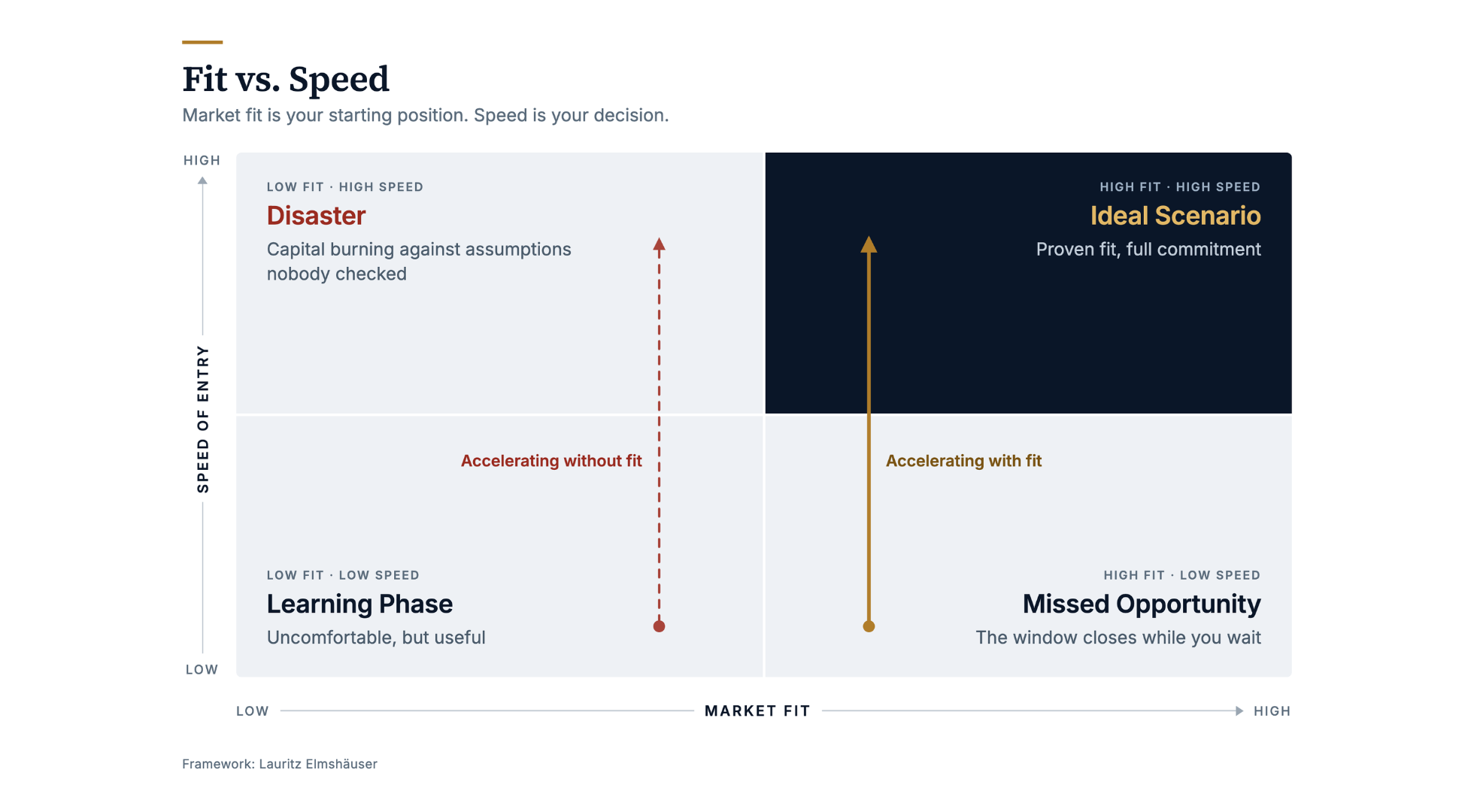
High fit combined with high speed is the scenario everyone puts in the pitch deck. High fit with low speed is a missed window. Low fit with low speed is simply a learning phase; uncomfortable, but useful. The disaster quadrant is low fit at high speed: capital burning against assumptions nobody checked.
Three questions tell you which quadrant you are actually in. Is there demonstrable demand for your specific offer, for you, rather than solely for your category? Does the market understand your value proposition without a paragraph of explanation? And can you win a first customer within ninety days?
If the honest answer is no, slowing down isn’t a weakness. Spotify entered Germany years after its UK launch, and did so deliberately: music licensing there required different negotiations, different structures, different timelines. Germany became one of its strongest European markets. Speed without fit is an expensive failure. Fit without speed is a missed window. Knowing when to wait is also a strategic decision.
What “different” actually looks like: the German edition
Every market has its own rulebook. Germany’s is well documented, and since it was the Moroccan cohort’s destination, we dissected it in the masterclass.
German B2B decisions are slow and consensus-driven. More stakeholders, more committees, longer timelines. That is not rejection; it is a process, and planning for it protects both your forecast and your nerves. Compliance functions as a trust signal: GDPR, ISO certifications, and local data storage aren’t bureaucratic hurdles but shortlist criteria in a market that buys reliability before features. References are currency, which means your first deal is a positioning question, not a revenue question. For most B2B companies, the real market isn’t the DAX or the startup scene, but the Mittelstand. Roughly 3.5 million mostly family-owned companies, hard to win and remarkably loyal once won.
Here is the part that generalizes: swap the nouns, and a version of this list exists for France, the UK, the US, the Middle East. The discipline is to learn the local edition before you commit, and then to treat its requirements as entry tickets rather than annoyances. WerinGroup, one of the nine Moroccan companies, offers a textbook example. During the program, the Casablanca-based IT talent firm was selected by the EBRD for a dual ISO 9001 and ISO 27001 certification, precisely the standards European enterprise clients quietly expect before a conversation gets serious. That is what taking a market seriously looks like.
Growth strategy and brand: the flanks of every entry
Market entry rarely succeeds on entry tactics alone. Growth strategy flanks it on one side, and brand on the other.
On the growth side, the risk is drifting into a new market by accident; one opportunistic deal at a time. The question founders should ask at least once a year is the 10x question: not “how do I get ten percent more out of what I already do?” but “what would need to be fundamentally different in three years?” The ten-percent question optimizes existing channels, which is safe but has a ceiling. The 10x question surfaces the levers the incremental one hides: a new business model, a redesigned revenue model, partnerships as multipliers. International expansion belongs on that list. If a new market shows up in your 10x answer, enter it as a deliberate go-to-market bet with measurable milestones, not as a side project that happens to have a flag on it. Then keep testing each additional, established market against the same 10x question.
On the brand side, one reframe changes everything. In a market where nobody knows you, brand is not your logo, your color palette, or your tagline. It is the sum of expectations people hold before they ever interact with you. Be aware, decision-makers google before they meet. That means three tools beat any campaign: one well-documented reference customer, a visibly credible founder, and local partnerships that signal you are serious. Trust in a new market is built bottom-up, through proximity and consistency, not through announcements.
What a week in Berlin makes visible
The Berlin week showed what this looks like when it is designed as a sequence rather than a moment. First, months of preparation on EU market entry strategy, international sales and regulatory requirements, and developing hypotheses on the new market. Then visibility: the cohort exhibited at GITEX AI Europe, alongside a Moroccan pavilion backed by the country’s investment and export agencies, and founders took the stage to discuss their business models, Morocco’s national AI strategy and its ambitions for international collaboration. Then the doors: Berlin Partner for the institutional view, Venture Café and CIC for community and capital, and a curated matchmaking evening whose declared measure of success was not attendance but that every guest “leaves with a concrete follow-up.” And after Berlin, the process continues: each company returns for a tailored market visit, working to get in front of the ideal decision maker, nailing product adoption, or convincing that first reference customer.
Augustine Kangni, one of the program’s mentors, compressed into one sentence what took me forty-five minutes of slides: “A lot of what shapes internationalization doesn’t show up in strategy decks. It becomes visible in conversation.”
The cohort itself proves the process view, as diverse as they appear, from fresh startups to seven-figure businesses. Whether eyeing first-time expansion across national borders or already operating in a dozen countries. Companies range from those first going abroad to those anchoring their European business with an office, while others are weighing which structure – an office, a subsidiary, a holding – gets them closest to European networks and investors. An anchor, a structure, a proof point. Different companies, same grammar.
Five questions before you enter any market
If you are considering a new market, Germany or anywhere else, sit with these five questions before you spend serious money. Certainty of success does not exist; new markets are ambiguity by design. Answering those first, though, will multiply your chances of success, reduce wasted time and energy, and cut costs. They are the masterclass in miniature.
- What is your hypothesis? Why should this market work for you specifically? Write down your assumptions about the customer, problem, and willingness to pay before spending a euro on the answer.
- Which quadrant are you in? Test for fit before you commit to speed. If you cannot name demonstrable demand and a realistic path to a first customer within ninety days, you are still in the learning phase. Act like it.
- What is your anchor? A local partner, a pilot customer, one person on the ground. Not an office. Not a legal entity. Proof first, structure later.
- What adapts – and what must not? Pricing, language, and process will bend to the local market. Your core product and your quality standard should not. Decide the difference in advance, or the market will decide it for you.
- Who exactly is your first reference customer? “German SMEs” is not a customer. A sector, a company size, a decision-maker, a buying trigger – that is a customer. Everything that follows is built on this one win.
The twelve-month question
I ended the masterclass with the question I find more useful than any framework: if you look back at today in twelve months and say “that was the turning point,” what would need to have happened between now and then?
If entering a new market is part of your answer, start where every good entry starts. Not with an office, a launch, or a press release, but with a hypothesis, an anchor, and the patience to win one customer who will speak for you when you are not in the room. Proof before revenue. Process before event. The rest follows.