
Everyone- entrepreneurs and managers, startups and corporates- everyone needs strategy, and everyone calls for innovation. Innovation is needed for long-term progress and without a strategy all your efforts will be gone in vain. To understand innovation and to work on a strategy, I start workshops and trainings with my favourite painting: the Wanderer above the Sea of Fog. And the question: what comes up in your mind when you look at it? What words, ideas, thoughts are popping up in your mind?
In 2020, after 10 years of workshops I conducted an analysis of all the answers. It did not matter where the answers came from. Asia, Africa, North America, Europe, all the same: “vision”, “opportunity”, “adventure”, “uncertainty”, “unknown”, “dark”, “loneliness”, “cold”, “fog”, “clarity”, “conquer”, “walk”, “explore” are some of the inspirations that resulted from the question about the painting. To summarize this brainstorming in one punch line: There is only one way to leave the comfort zone. You have to conquer the fog. Regardless of whatever is waiting for you behind the fog, despite all guesswork about risks, threats, failures: Accept the fuzziness and inexactness of this journey. The more you conquer the fog, the more clarity you gain and the more it makes sense.
But talking the talk is easier than walking the walk. Therefore this text is a recommendation for mind-set, skill-set and tool-set to drive innovation with a strategy that supports this long-term endeavour. For startups as well as corporates.
Mind-set: Be open, be curious, be courageous
You are a founder, an entrepreneur who is working on his own business. So you are familiar with fog. You are the Wanderer above the Sea of Fog. You have a vision about the horizon but the path towards this goal is unclear and uncertain. In the VUCA world this is called ambiguity, an environment that is defined by the unknown number of unknown unknowns. It is the fog. But what you need is clarity – the opposite of fog. This need is totally normal for the human mind. What strategic approach could be applied to set the mind right? 2×2 matrices are very popular in strategic exercises.
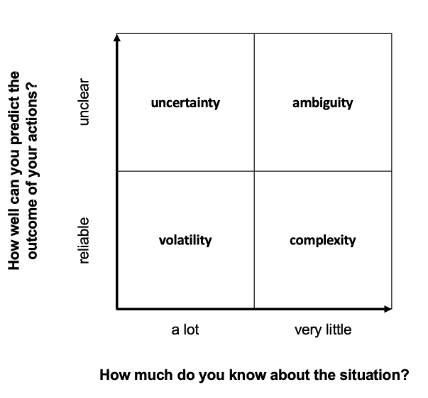
VUCA is easily explained and easily applicable: two observations are scaled from “everything is known” (aka clarity) to “everything is unknown” (aka fog). You can start with the first observation “What do I know about the situation?” Thinking about the situation is thinking about the market, the users, the competition and what do you know about it. Be careful: do not fall into the bias pitfall. The question is what you know and not what you assume. In a workshop about the future of sales one participant said: “Our clients want to have a direct contact. Personally, I don’t want to receive emails that blow out my inbox. I want to be called directly.” The sad truth was he did not know anything about his clients. He made himself the centre of the universe and the pitfall was his self-fulfilling prophecy.
This example leads to the second observation: “How well can I predict the consequences of my actions?” If in this example the sales manager would start calling his clients, he would think that they would appreciate his contact approach. Again, the truth is, he doesn’t know. Simply because he started to evaluate the situation with facts that were not facts. They were assumptions. Treating assumptions like facts is like starting a marathon with loose shoelaces.
As an entrepreneur, you are dealing with fog. No knowledge about the situation, no knowledge about the consequences of your actions. Your mindset needs to be humble and open to the new and unknown. You have to embrace the fog like a dry sponge that soaks in all the data and information about your new playing field to gain real wisdom.
Skill-set: Know and cultivate your innovation discipline
Probably the most relevant skill-set to drive innovation is the distinction between observation and assessment. The necessary foundation for that is the open and humble mind-set. Only then do you start observing the domain and the problems without immediate assessment. When you are not open and humble, your assessments will be arbitrary. Like treating assumptions as facts. As a founder with the right mind-set you are ready to start dealing with a domain you do not know anything about.
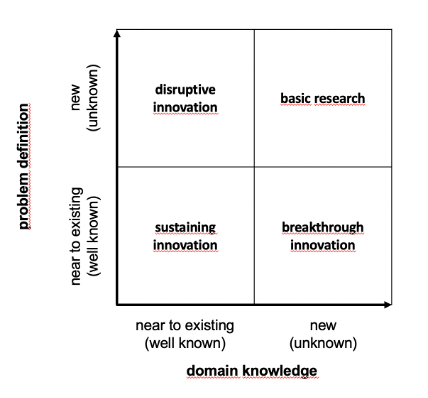
That can be your market, your users, your technology and you should treat it with openness and devotion to gain as much wisdom as possible. When you clearly separate your data (aka your observations) from your analysis (aka your assumptions) you will be able to really understand the problems. This understanding becomes your competitive edge, your unfair advantage, your unique selling proposition. But you gain this understanding only, when you create a discipline that distinguishes between observation and assessment.
Tool-set: No tool-set without mind-set and skill-set
First we set the mind right, then train the appropriate skills, finally we have to pick the matching tools. To do that we need to know how we can solve a problem. Here comes the last 2×2 matrix, the Stacey Matrix. It compares the two questions “How to solve a problem?” with “What are the objectives and requirements?” and like before scales from known/clarity to unknown/fog.
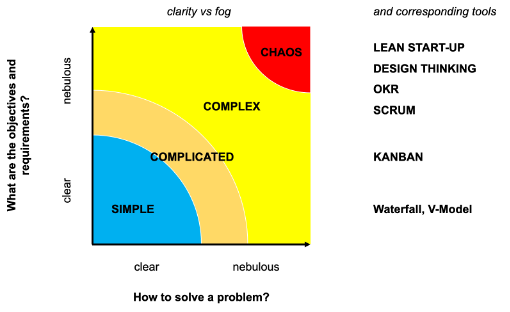
Let me give you an example. Via enpact I worked with an entrepreneur from North Africa. Her objective was to expand her business to Europe and the Gulf States (GCC). An entrepreneur with a vision about the horizon and a sea of fog in front of her. When we worked together we started with the mindset. In her status quo she was successfully active in North Africa. Europe and GCC are two completely different markets. We had to avoid the pitfall that the problems of her current customers are the same as in Europe and GCC. Of course she had experience and knew her domain. That is important. She didn’t start from scratch. She was able to make very educated guesses. But still guesses. That is why in a second step we defined a discipline on how to do the basic research in these new markets. After these first two steps we picked the tools for her new business endeavour. She had an idea on how to solve the problem and her objectives were pretty clear: more contracts, more clients, revenue growth. But be careful! These objectives are just results. A logical consequence when you are successfully doing the right things. But what are the right things? These are the real objectives and requirements. Plus they are very different in Europe and GCC. Following the Stacey matrix we choose objectives and key results (OKR) as the tool of choice.
Strategy: To conquer the fog you need to create clarity
Question: what about strategy now? In short, to conquer the fog you need to create clarity. The starting point is the fog.

This is where the Wanderer begins her walk and the only way to get to the horizon is creating clarity. You create clarity by precision. Precision comes with concreteness and specificity. An objective like “more customers” or “more revenue” is too general. In fact, general statements create too many different ideas about what the general statement means. General statements create more fog. That is counterproductive when you want to create clarity.
For the innovation strategy you need the right mind-set. Humble, open, curious and courageous about what is behind the fog. A mind-set that embraces the beauty of the fog. With that mind-set you need the skill-set to create clarity. That is a challenging discipline because it is too tempting to think about ideas and solutions before thoroughly understanding the problem. Finally, the tool-set is classic: Design Thinking, OKR, SCRUM, Lean Startup – the whole keyboard of the startup life. But why do established companies and corporates still fail when applying these tools? The tools are great but without the right mind-set and the necessary skill-set, tools are useless to conquer the fog.