If you start a company, you pitch. Not occasionally. Not just on Demo Day. From the very first second. You pitch your idea to friends over coffee. You pitch why this idea is worth giving up comfort for. Furthermore, you pitch potential co-founders on why they should gamble their time, reputation, and sanity alongside you. You pitch investors, customers, partners, and early hires. And if things go really well, you’ll pitch your exit one day.
Bottom line up front: pitching never leaves you. It is not a moment. It is a condition.
Yes, it’s selling your idea. But no, it’s not sales.
Yes, as a founder, you are part of the product. You are literally baked into the pie you’re serving. Which means that pitching the company you co-founded is, whether you like it or not, also self-selling. And yes, you are selling a mission you actually care about.
Most founders hate this. Many cringe at the thought of “selling themselves” and like to mistake that discomfort for integrity. That may feel noble. It is also useless.
Pitching is not a personality flaw. It is a structural necessity. Creating something that does not yet exist requires others to believe before there is proof. Companies do not move from non-existence to existence through purity of intention. They move because people get on board. And people get on board because they are, very simply, sold on an idea. You can resent that fact. Or you can work with it.
Over the years, I have supported thousands of founders in elevating their pitching skills. Check out the following dos and don’ts.

Start With Who
You are usually not pitching end customers. You are pitching people whose literal job it is to listen, evaluate, and say no. Investors. Stakeholders. Decision-makers. People with opinions, pattern recognition, and crazy confidence that their assessment is probably right.
Therefore, always start with “Who am I pitching to, and where are they at?” Because a different audience requires a different pitch, as they listen differently.
Investors listen for scalability and risk. Co-founders listen for meaning, honesty, and survivability. Customers listen for value. Partners listen for alignment.
Pitching is not a monologue. It is a translation. If you use the same story for everyone, you are not being consistent. You are being lazy.
So, everything starts with the hard path to precision.
Squeezing A Universe Into Four Minutes
A pitch is the attempt to squeeze something huge, complex, and alive into three or four minutes. By definition, a pitch is too short to tell the whole story. Preparation is therefore not about adding. It is about cutting. Ruthlessly. You all know the sentence: “I would have written a shorter letter, but I did not have the time.” That sentence explains pitch preparation perfectly.
Clarity takes work. Brevity is expensive.
A Pitch Is Not An Advertisement
This matters more than most founders think. A pitch is not an ad, not a trailer, not a hype reel, not punchy lines, and not inspirational bullshit. There is nothing more cringeworthy than a pitch that tries too hard to impress.
A pitch must assume intelligence on the other side. You are not trying to seduce an audience – you are trying to convince thinking adults! That means you strip the idea down until it becomes undeniable.
You explain what it is, why it exists, what problem it solves, and how it works. Then, and only then, you draw the vision. Now you are allowed to touch the dream buttons a tiny little bit.
The Cultural Technique Of Pitching Is A Love Letter To Curiosity And Abundance
Pitching has a bad reputation because it is often shallow and rushed. In reality, the intention behind pitching is the opposite. The world contains more interesting ideas, companies, and possibilities than one human life can ever explore. There are more people worthy of meeting than you can ever meet. There are more startups worthy of investing in, founding, or supporting than a single person ever can.
Pitching is an act of respect for that reality. By expressing ideas clearly and briefly, we get to experience a tiny, little weeny bit more of what the world has to offer. In that sense, pitching is not manipulation. It is a small love letter to abundance.

Thank God For LLMs
Most founders pitch in English rather than their mother tongue. It’s definitely not my mother tongue. And having to express myself in English always feels like amputating half my brain. Explaining something complex in a foreign language, under time pressure, is brutal. Now, thank God, you have to worry slightly less about that. AI will save your non-native, cognitive, tax-paying ass. Large language models are genuinely good at one thing all founders desperately need: structuring language.
Open your favorite LLM. Do not write. Speak. Record yourself rambling. Unstructured, messy, a raw story of what you’re trying to convey. Speak in Arabic, speak in French, speak in German. Then feed that transcript into an AI, and ask it to structure it and, of course, translate it into English. Heads up: LLMs tend to get fluffy and marketing-sounding. Precision still comes from your thinking. AI just helps you see it. So be explicit in your prompt: do not invent, do not embellish, do not delete meaning. Ask it to organize, point out what is unclear, and flag what is missing. AI will save you a lot of expensive pitch coaching.
Slides Won’t Save You
Slides will not save bad pitching. They matter less than you think. Early-stage investing is about people, clarity, and key messages. Slides are not your script. They are a second cognitive layer for orientation.
Make slides as brutally simple and visual as possible. No information on the slide should be visible that you haven’t mentioned yet. You lead the narrative; the slide follows you and visualizes your thinking.
Voice, Pace, And Presence Matter More Than You Think
Words matter. But without voice and pace, they don’t carry meaning. How you sound instantly transmits information: Do I trust this person? Are they grounded? Do they know what they’re doing? Energy matters. Passion matters. But too much excitement erodes sovereignty.
A good pitch voice is calm, awake, and alive. Not rushed. Not theatrical. Not cute.
There is also a practical reason this matters. At Demo Days, after the fifth pitch, the brain turns to mush. A voice with pacing, pauses, and intention cuts through cognitive fog.
When time is tight, the instinct is to talk faster and cram more content in. Speaking fast has a terrible ROI for your life’s energy. The cost of speaking too fast and saying too much is higher than the cost of saying too little. Speed destroys gravitas. Preparation buys you calm, and calm buys you authority. Your company deserves that gravity. And we all know you have the gravitas. Otherwise, you wouldn’t start a company at all.
Your Body Is Already Speaking
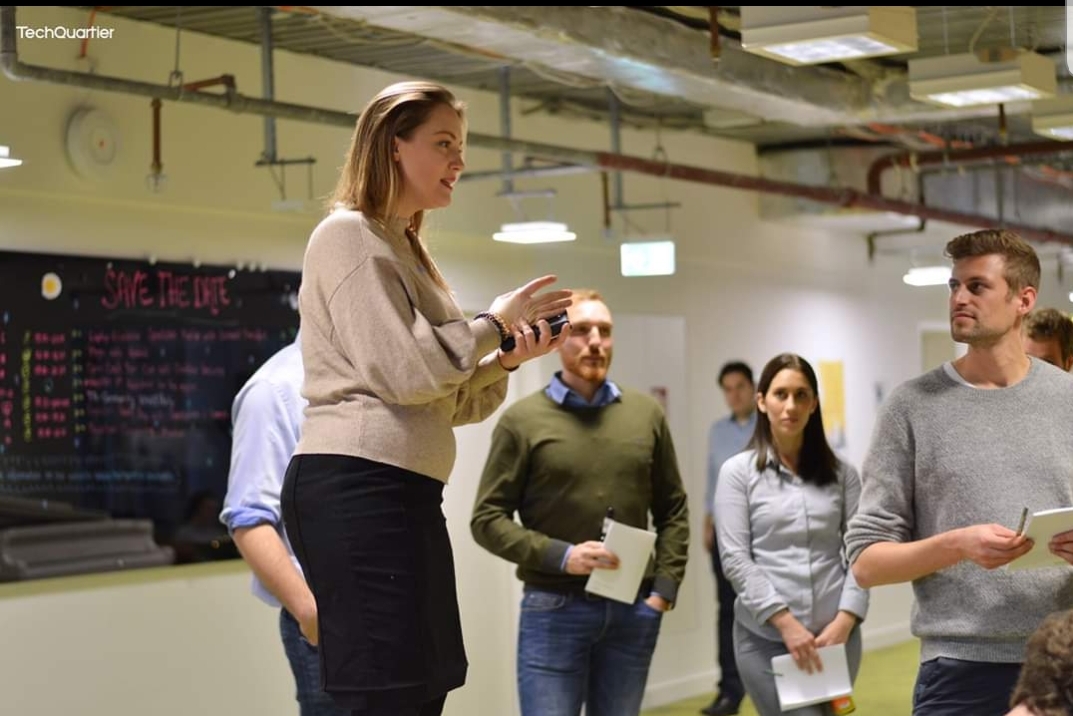
Pitching is usually public speaking, which triggers self-consciousness. Hands end up in pockets, on clickers, on pens, anywhere but where they belong – in the wild and moving. Use your hands. There is a massive difference between someone who speaks with their whole body and someone who is trying to disappear on stage.
You are visible. Hiding does not work in the spotlight. Make peace with being seen.
Context Is Not Optional
If you pitch institutional investors, understand the narratives of your industry. Know what they see every week, what patterns they recognize, and what clichés they are tired of. You do not need to follow trends, but you do need to understand the language of the room. Timeless ideas still need timely framing.
Public Speaking Is A skill. Skills Can Be Trained
Your pitch is a piece of craft. It deserves time, sweat, and attention. Write it out. Say it aloud. Get feedback. Listen to your gut. Iterate. Repeat. Every round teaches you something, and your pitch will keep evolving because you do.
At the same time, do not fall into the trap of needing to be entertained by your own pitch or its novelty. Make peace with boredom. You will repeat this story countless times over many years. That is not a failure; it is the job.
Embrace the repetition. Get your personal sense of play from the delivery, not the content. Lock the content. Lock the story architecture. Strip it of all fluff until you enjoy every word, not because it is clever, but because it is true.
And if pitching scares you, park that fear. Label it. Promise to revisit it after your exit. You will need this skill. If you even learn to enjoy it a little, founder life gets lighter, clearer, and very likely more successful.